

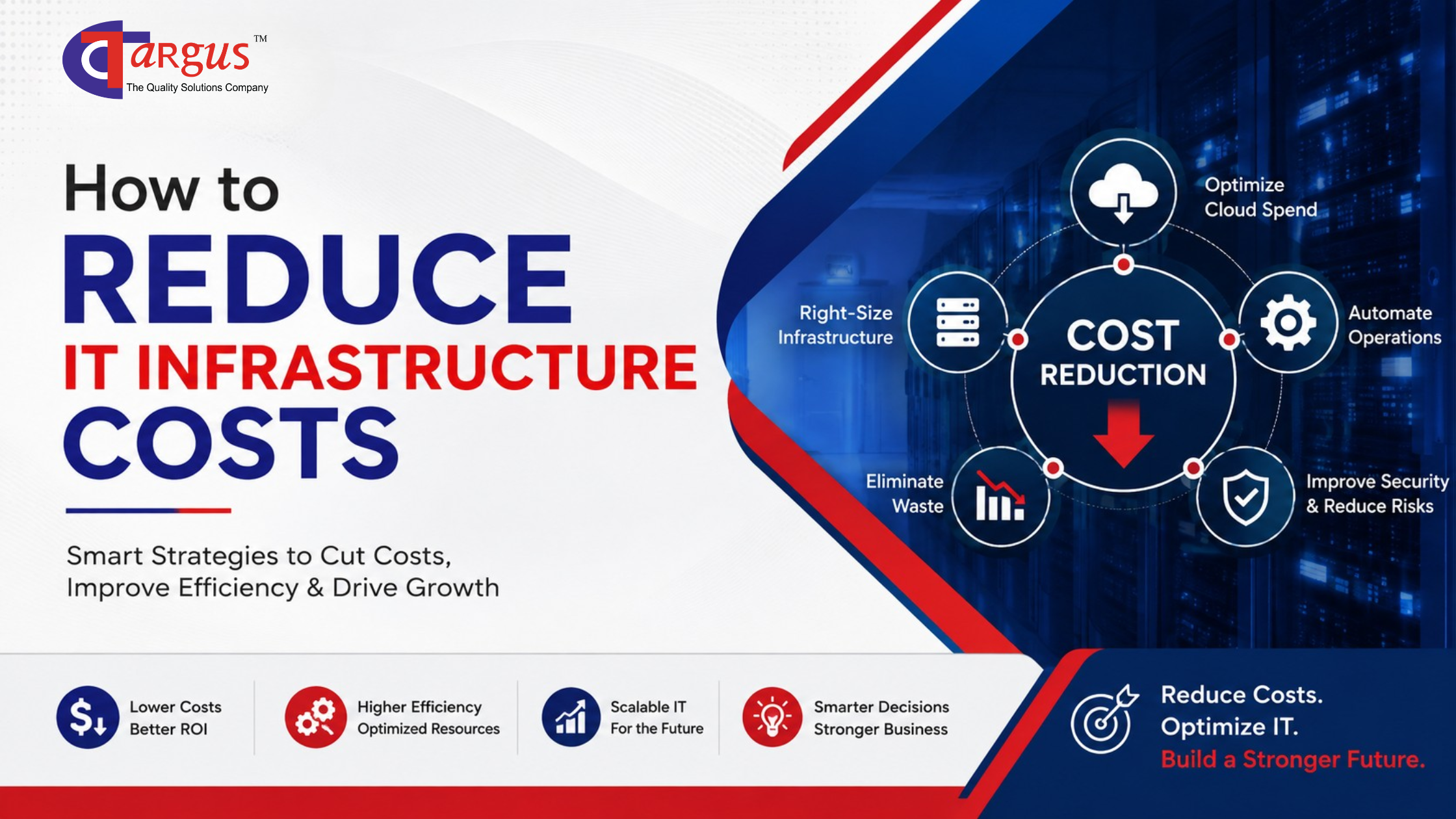
Every financial review eventually lands on the same line item: IT infrastructure costs that seem to grow every quarter, regardless of whether the business has grown with them. It’s rarely one runaway expense causing it. It’s usually a dozen small ones: a server sized for a traffic spike that never came, three overlapping software tools nobody remembered to cancel, a support contract renewed automatically without anyone checking the market rate.
The instinct when costs climb is to cut, freeze spending broadly, delay upgrades, push off the server refresh another year. That approach tends to backfire, because it treats every cost the same way, when the real opportunity is in finding out which costs are structural waste and which are the ones actually keeping the business running safely. This is what an honest cost reduction process actually looks like, based on the audits we run for clients at Targus Technologies before we recommend anything.
Start With an Honest Audit, Not a Budget Cut
The starting point isn’t a spreadsheet of “things to cancel.” It’s a structured audit of everything currently being paid for: hardware, software licenses, cloud spend, support contracts, and personnel time mapped against what’s actually being used. Most organisations are surprised by what this turns up. It’s common for enterprises to be running IT infrastructure sized for peak demand that was estimated generously years ago, with the result that servers and cloud instances sit well under their real capacity while being paid for at full price.
A useful way to frame the audit is by asking, for every major infrastructure component, three plain questions: what is this actually used for right now, who would notice if it disappeared tomorrow, and has its capacity or cost changed since it was first provisioned? Components that fail all three questions are the ones worth investigating first; they’re usually either genuinely unused or so poorly documented that nobody can say for certain either way, which is its own kind of risk.
The audit matters because cost reduction without visibility just moves the waste around. Cutting a contract nobody understood the purpose of might save money for a quarter and cause an outage the next.
Where the Real Savings Usually Are
Cloud rightsizing
Cloud infrastructure gets blamed for rising costs almost as often as it gets praised for flexibility, and both reputations are earned. Unmanaged cloud resources can account for a meaningful share of a mid-sized business’s total cloud spend: instances running at a fraction of their allocated capacity, storage tiers that were never adjusted after initial setup, and services left running after a project wrapped up. Rightsizing compute instances, applying storage lifecycle policies, and using automated scaling instead of static provisioning typically recovers a substantial share of cloud costs without touching performance.
Vendor and software consolidation
The average organisation now runs a surprising number of separate software applications across departments, and a meaningful portion of those licenses go largely unused. This is often called SaaS sprawl, and it happens quietly: a department signs up for a tool, another team buys something similar without knowing, and nobody owns the job of checking for overlap. A structured “keep, replace, retire” review, department by department, is one of the highest-leverage cost reduction exercises available, because the savings are direct and immediate once duplicate tools are identified.
Consolidating data centre and server footprint
Businesses that have grown through acquisitions or rapid expansion often end up running more physical infrastructure than they need, with significant overlap between systems that were never properly merged. Consolidating server and data centre footprint through virtualisation, workload migration, or moving appropriate workloads to managed data centre services reduces both the direct hosting cost and the ongoing maintenance burden of running duplicate infrastructure.
Reviewing IT infrastructure solutions against actual usage patterns, not initial assumptions
IT infrastructure solutions are often designed around assumptions made at the time of initial deployment: expected growth, expected traffic, expected headcount. Those assumptions age. A periodic review that compares actual usage against original sizing decisions, ideally annually, catches the gap before it becomes years of accumulated overspend.
Shifting from reactive support to managed IT services and support
Unplanned “break-fix” support paying a contractor or vendor only when something breaks feels cheaper in isolated moments but tends to cost more over a year, both in unpredictable invoices and in the downtime that happens while waiting for a response. Structured managed IT services and support convert that unpredictable cost into a fixed, budgetable one, while also catching problems before they become expensive emergencies.
Automating routine operations
Manual patching, manual monitoring, and manual license tracking all consume staff hours that could go toward higher-value work. Automation tools for network monitoring, SaaS license management, and routine maintenance reduce the labour cost hidden inside “just keeping the lights on,” which is often a larger share of the IT budget than most finance teams realise.
The Cost Reduction Levers That Look Cheap but Aren’t
Not every cost-cutting move actually saves money once the full picture is accounted for. A few patterns worth watching for:
- Delaying hardware refreshes past their useful life often costs more in maintenance, downtime risk, and lost productivity than the replacement would have cost.
- Switching to the cheapest available managed service provider services without checking scope can mean paying twice: once for the cheap contract, and again when gaps in coverage cause an incident the contract didn’t cover.
- Cutting security spend to hit a budget target is one of the more common expensive mistakes; a single security incident routinely costs more than years of the security budget being trimmed.
- Reducing staff without redistributing their responsibilities to either automation or a managed partner just moves the workload onto whoever’s left, usually at the cost of the very responsiveness the cut was meant to protect.
Cloud vs. On-Premises: Getting the Balance Right
Cloud infrastructure is genuinely one of the more effective ways to control costs, largely because it removes the need to over-provision physical hardware for demand that may never arrive. But cloud isn’t automatically cheaper for every workload; data-heavy, latency-sensitive, or highly regulated workloads sometimes cost less to run on managed servers or in a data centre over a multi-year horizon than in the cloud. A hybrid approach, where each workload is placed based on its actual cost and performance profile rather than a blanket policy, tends to produce the most efficient outcome for mid-sized and large organisations alike.
Where a System Integrator Changes the Cost Equation
This is where the choice of partner matters more than businesses often expect. A system integrator that only sells hardware or licenses has limited incentive to recommend consolidation, since consolidation reduces what they sell. A genuine managed solutions provider one whose ongoing relationship depends on your infrastructure actually working efficiently, not on selling you more of it has the opposite incentive. That difference shows up directly in whether a cost audit results in an honest recommendation or a bigger invoice.
If you’re evaluating system integrators in Delhi or elsewhere for this kind of review, it’s worth asking directly how their commercial model is structured, and whether their recommendations would change if efficiency, rather than sales volume, were the only goal.
Measuring Whether It Actually Worked
Cost reduction efforts often stall out because nobody defines what “worked” looks like beyond the first invoice after the change. A more reliable approach is to track a small set of metrics over two to three quarters: total infrastructure spend as a percentage of revenue, average cloud utilisation rate, number of active software licenses versus active users, and unplanned downtime hours. If spend drops but utilisation or downtime gets worse, that’s not a cost reduction; it’s a deferred cost that will show up later, usually at a less convenient time.
It’s also worth revisiting the audit findings against actual outcomes after implementation. A rightsizing exercise that promised a certain percentage of cloud savings should be checked against the actual bill three months later. Discrepancies between projected and actual savings usually point to a step that got skipped, not a flawed strategy; commonly, a workload that got resized on paper but never actually migrated, or a software license that got flagged for cancellation but stayed active because nobody followed through with the vendor.
A Realistic Way to Approach This
Cost reduction works best as an ongoing discipline, not a one-time project. Savings identified during an initial audit tend to erode within a couple of quarters if nobody continues monitoring usage against provisioning. The organisations that keep costs under control long-term treat the audit as the start of a recurring process: quarterly reviews of cloud usage, annual reviews of software licensing, and a standing question, whenever new infrastructure is proposed, of whether it’s sized for today’s actual need or yesterday’s rough estimate.
How Targus Technologies Helps
We’ve run infrastructure cost audits for businesses across manufacturing, finance, healthcare, and retail as part of our IT Infrastructure, Data Centre, and Managed Services work, including organisations like Airtel, Fortis, and Tata 1mg. As a CMMI Level 5 and ISO-certified system integrator, our reviews focus on where spend and actual usage have drifted apart, not on which upgrade we’d like to sell next.
If your IT budget has been climbing without a corresponding increase in what the business is getting from it, that gap is usually visible within the first proper audit before any decisions get made about what to cut. It’s a more useful starting conversation than any generic list of “cost-cutting tips,” because it’s based on your actual infrastructure rather than an average business that may look nothing like yours.
Frequently Asked Questions
How can a business reduce IT infrastructure costs without hurting performance?
Start with a structured audit to separate genuine waste (overprovisioned capacity, unused software licenses, redundant tools) from infrastructure that’s actually needed. Cutting broadly without that visibility risks removing capacity the business depends on.
What is the fastest way to lower IT infrastructure costs?
Cloud rightsizing and software license consolidation typically produce the fastest, most measurable savings, since unused cloud capacity and duplicate SaaS subscriptions are common and directly quantifiable once identified.
Is moving to the cloud always cheaper than on-premises infrastructure?
Not always. Cloud is often more cost-effective for variable or growing workloads, but data-heavy, latency-sensitive, or heavily regulated workloads can sometimes cost less on managed servers or in a data centre over a multi-year period. A hybrid approach, evaluated workload by workload, usually produces the best balance.
What IT costs should never be cut to save money?
Security spending and infrastructure past a reasonable maintenance threshold are the two most common places where cutting backfires; both tend to create higher costs later through incidents or downtime than they save upfront.
How often should a business review its IT infrastructure costs?
An annual full audit is a reasonable baseline, with quarterly reviews of cloud usage and software licensing in between, since unused capacity and subscription sprawl tend to reaccumulate if nobody continues monitoring them.
How can Targus Technologies help reduce IT infrastructure costs?
Targus Technologies conducts infrastructure and cost audits across networking, servers, cloud, and data centre environments to identify where spend and actual usage have drifted apart, backed by CMMI Level 5 and ISO-certified delivery and nearly three decades of system integration experience.

